

At first, Thessaloniki market food tours look almost too simple.
Two markets. A few stops. Something to taste here, something handed to you there. Walk, eat, keep going.
Easy to picture.
Then you zoom in a bit. Try to imagine how it actually moves. Where you turn, how long you stay, what happens in between.
It doesn’t stay neat for long.
These tours don’t sit still. They slide through the center in layers. One stretch feels tight and loud, almost pushing you forward. Then suddenly it opens — a wider street, a pause, maybe a table. Then back in again. You don’t just stop for food. You keep shifting through different versions of the same place.
That shift carries everything.
It’s not really about ticking off Kapani or stepping into Modiano. It’s the stretch between them. The way the streets narrow without warning. The way the pace changes. One minute it’s messy and fast, the next it feels almost arranged.
Most tours build around the market district because it already holds everything in one place. You move, you taste, you see how things actually work on the ground.
It ends up feeling closer to how the city runs than a fixed list of stops.
- Best tours → see options
- Kapani → market guide
- Modiano → market guide
- Prices → cost guide
Why market food tours sit at the center of the Thessaloniki experience
You can walk into Kapani on your own. Same with Modiano. No one stops you.
At first, that makes the guided version feel unnecessary.
Then you’re inside.
You check your phone once. Then again. One turn looks like the next. A side passage pulls you off without noticing. You pass something interesting, hesitate, keep walking, then can’t find it again.
The area doesn’t separate cleanly. It spills. One street blends into another, then into a small square, then back into stalls again. Bakeries tucked between meat counters. Delis next to spice shops. You don’t really “enter” or “leave.” You just… drift.
That’s where the tour starts to make sense.
Instead of circling without direction, you fall into a route. Not rigid, but steady. You start somewhere on purpose, then move through a sequence that actually holds together — not by distance, but by how it feels to walk it.
The city is already compact. Everything sits close. No transport, no long gaps. You just keep moving.
And at some point, you stop checking directions.
| Format | How it works | What you feel | Best for |
|---|---|---|---|
| Market food tour | Walk through Kapani, Modiano, and surrounding streets with tasting stops | Layered, shifting, structured | First-time visitors, short stays |
| Street food tour | Faster stops across the city center | Loose, quicker, more casual | Quick overview, lighter experience |
| Private food tour | Flexible route with adjustable pace | Slower, more controlled | Couples, families, slower travelers |
What a Thessaloniki market food tour actually includes
From the outside, they look almost identical.
Three to four hours. Central walk. A handful of stops. Food included.
Sounds clear enough.
Then you try to imagine the timing.
You’re not sitting down for a full meal. Not really. You stop, taste something, move again. Sometimes you stand. Sometimes you lean on a counter. Once in a while, you sit longer than expected and lose track of the group for a second.
It builds slowly. One thing early — something small, just to start. Then another when you’ve settled into the pace. Then something heavier when you’re already deep inside the market flow.
It doesn’t line up neatly.
-
A moving route, not a fixed location
You keep shifting — street to stall, stall to shop, then back outside again. -
Tastings spread across the walk
Small things, one after another. You don’t notice how much you’ve eaten until later. -
Different market environments
Open sections, covered halls, narrow lanes — each one feels slightly off from the last. -
A guide who frames what you’re seeing
Without it, it’s just noise. With it, pieces start clicking into place.
You fall into a rhythm without really deciding to.
Walk. Stop. Taste. Move again.
After a while, it just… carries you.
How the route starts: easing into the market district
Most tours don’t drop you straight into the busiest part.
They hold back a little.
You meet just outside. A bakery, maybe. A corner spot where you can stand without being pushed along. People arrive slowly. Someone checks the map again even though it’s the right place.
It doesn’t feel like much yet.
Then you start walking.
The space tightens almost without warning. The sound shifts first — voices stacking, metal trays, quick exchanges. Then the streets narrow. You slow down, not by choice, just because you have to.
You stop noticing the route and start reacting to what’s around you.
That’s usually where Kapani pulls you in.
And somewhere around there, it stops feeling like a planned walk.
Kapani: where the tour stops feeling organized and starts feeling real
Kapani doesn’t announce itself.
You’re walking, checking your phone for the route, thinking you’re still outside it. Then the street tightens. Someone brushes past you with a crate. A stall leans into the walkway. Another cuts across. You look up — already inside.
It gets louder. Not all at once. Just layers stacking.
You try to keep a straight line for a minute or two. Doesn’t hold. People drift across you, someone stops mid-step, a delivery slips through a gap that barely exists. You adjust without thinking. Everyone does.
The group stretches a little here. You notice it. Someone hangs back at a stall, someone else edges ahead, and for a second you’re not sure who you’re following.
Tours hit this section early for a reason.
If you walked in cold, it would feel like too much — noise, movement, everything happening at once. Coming in after a slower start, it lands differently. You don’t fight it. You just fall into it.
Stops don’t last long.
A bite handed over. A quick pause. You’re stepping aside before you even finish chewing because someone needs that space. You don’t really get to settle — and no one’s trying to make you.
At one point you reach for your pocket, thinking you dropped something. Just your phone shifting. Still — that moment sticks. You’re paying attention in a different way here.
What stays isn’t only the food. It’s how close everything sits. Buying, selling, walking — all stacked together, no clean edges between them.
Kapani doesn’t pause for you. It just keeps moving.
The shift: stepping out without really leaving
Then it loosens.
Not a clear exit. No sign, no gate. Just a bit more air between people. The sound drops slightly. You notice your pace changing before you realize why.
You glance at the map again. You didn’t need to, but you do anyway. Habit.
On your own, this stretch might pass without much thought. Just a few streets, nothing special.
Inside the route, it lands differently. Feels like a breath you didn’t know you needed. You stop reacting to everything around you. Start noticing again — buildings, corners, where the group actually is.
Someone asks a question. The guide answers slower than before. You’re standing still longer than you were back there.
It holds the whole thing together.
Without it, everything would blur into one long push. With it, the second half comes in cleaner. Not softer. Just easier to take in.
You’re still in the same area. It doesn’t feel like it.
Modiano: the same idea, but held in place
Modiano feels contained.
You can see how it’s laid out. Lines make sense. Your eye follows things without effort. Even when it’s busy, it doesn’t spill over in every direction.
After Kapani, it almost feels calm — even if it’s not.
You stop without being pushed aside.
The pauses stretch. You look properly this time. What’s on the counter, what people are ordering, how long they stay. No one rushing you along.
At one stop, you think about sitting. You don’t — but you could. That’s new.
Still a market. Still active. Still loud in its own way.
But your movement changes.
You’re not dodging anymore. You’re choosing. Where to stand, where to move next, when to stay a bit longer than expected.
You lose track of the group for a second again — but this time it’s because you stopped, not because you got pushed.
That contrast carries the whole route.
If both places felt the same, it would flatten out fast. One would blur into the other. Instead, one compresses everything. The other gives it shape.
Somewhere between those two, it clicks.
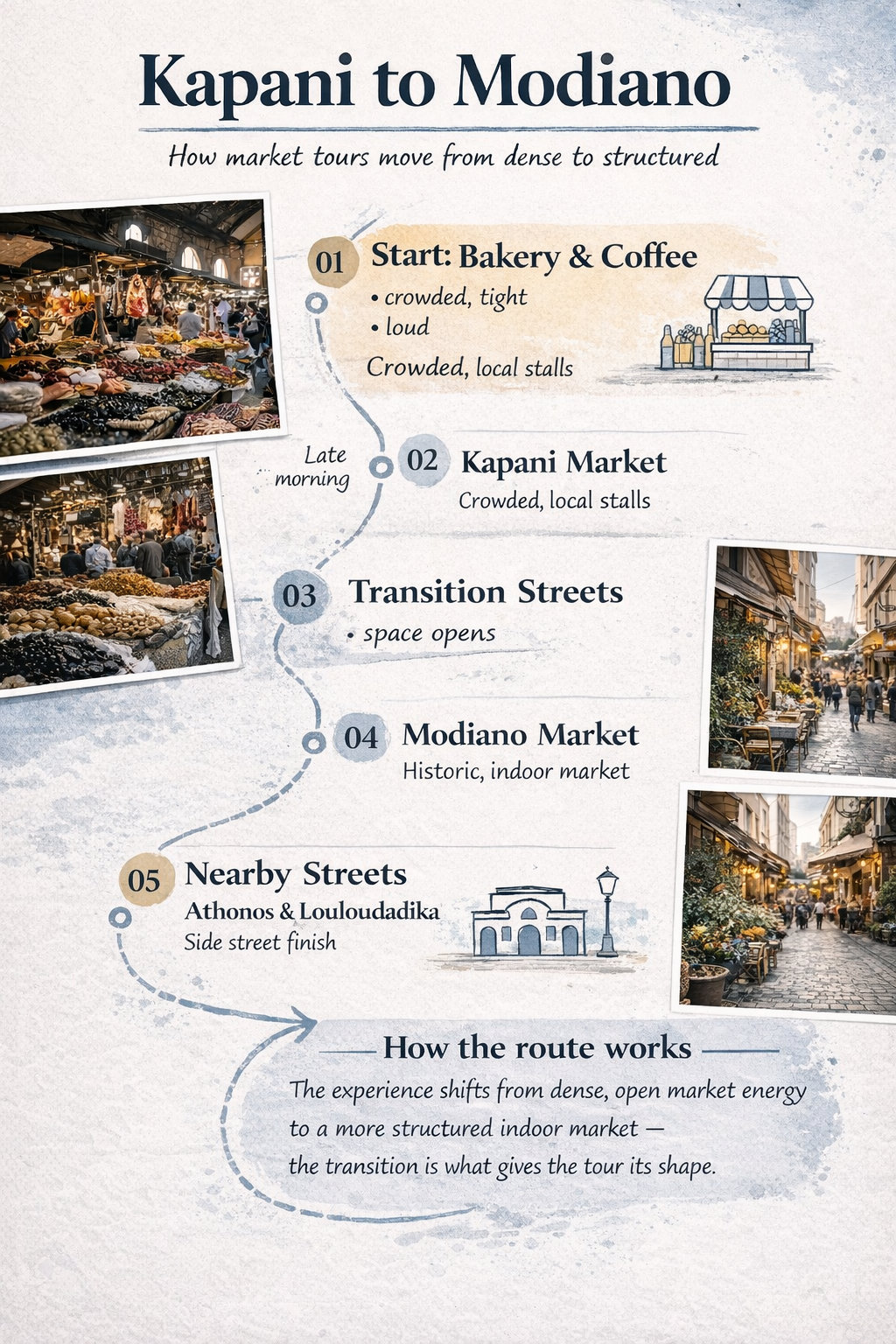
How the full route comes together
Looking back, it’s not random.
It builds on itself.
-
A softer entry point
You start just outside the tightest part. Enough space to settle in before things close around you. -
Kapani as the pressure point
The route drops you into the most compact stretch where everything overlaps and moves at once. -
A partial release
Streets open slightly. You slow down without deciding to. -
Modiano as the second register
Same idea of a market, but held together. Easier to read. Easier to stay in place. -
Outer streets to close the loop
The route stretches outward, then settles, without breaking what came before.
That progression does more than the stops themselves.
You’re not ticking locations off. You’re moving through different ways the city handles food — tight, open, contained, stretched out.
What sticks isn’t always a single tasting. It’s that shift — from being pulled through Kapani to standing still in Modiano — that gives the whole walk a shape you can actually remember.
Kapani vs Modiano: why both are needed in the same tour
At first glance, one feels like enough.
They sit close together. Same area. Same kind of place.
You walk through both, and it doesn’t feel interchangeable.
| Market | How it feels | How you move | What it adds to the route |
|---|---|---|---|
| Kapani | Dense, loud, a bit chaotic | Reactive, constantly adjusting | Sets the intensity and pulls you into everyday flow |
| Modiano | Structured, contained, easier to follow | Slower, more deliberate | Gives the route shape and space to actually take things in |
One pulls you forward. The other lets you stop.
Take one out, and something feels off. Too clean. Or too rushed.
Together, it lands right — even if you only notice that later, when you’re already walking away.
What you actually eat along the route
You notice the food a bit late.
At first you’re just keeping up — turning corners, stepping around people, checking where the group drifted. Then something gets handed to you. Warm. Quick. You take a bite while still walking.
Nothing lands like a full meal. No long pause. No moment where you sit and reset. It comes in pieces, spread out, tied to where you are more than how hungry you feel.
Some things show up almost immediately, before you’ve settled into the rhythm. Others come later, when you’ve stopped thinking about what’s next and just follow along.
It doesn’t line up neatly.
Still works.
What usually shows up on a market route
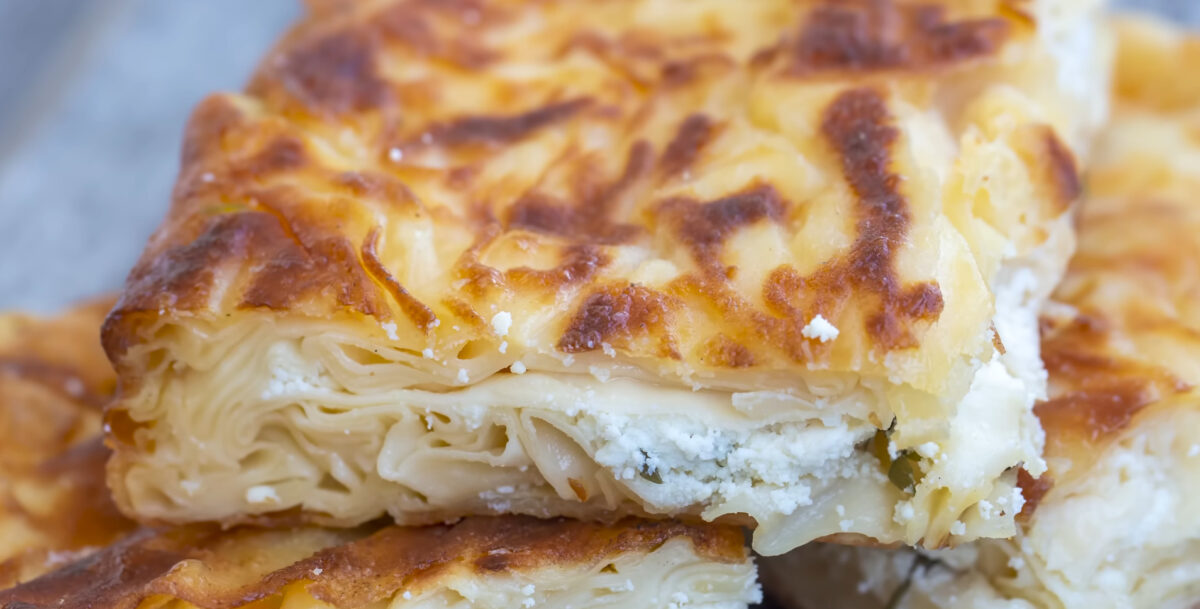
- Bakery-style starts that slow you into the walk
- Quick savory bites inside or just outside the market grid
- Deli tastings — cheeses, olives, spreads you don’t always recognize at first
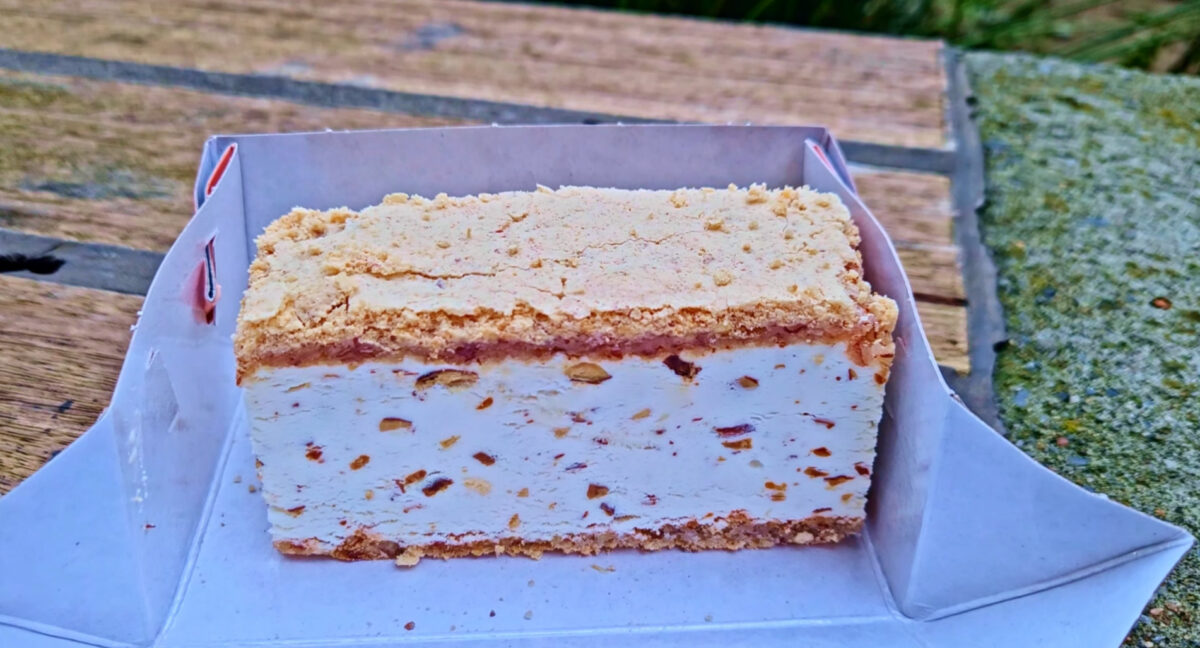
- Sweets that appear later, almost when you’ve stopped expecting them
- Coffee or drinks, sometimes squeezed in between stops
You don’t track the order.
You remember small things instead. Wiping your hands on a napkin while walking. Looking up to check if you’re still following the right group. That moment where you think you’re full — and then something else appears.
It stays tied to the movement. Not separate from it.
Who this format works best for
You don’t need a route to eat in Thessaloniki.
You can just walk in, sit somewhere, stay too long, order another thing because it looks good. No structure at all. The city handles that fine.
This format pushes you differently.
It packs the center into a few hours. Gives it a kind of shape you probably wouldn’t build on your own — not because you can’t, just because you wouldn’t think to connect it that way.
| Traveler | Why this works | Where it may not |
|---|---|---|
| First-time visitor | Gives you a fast read of the city through food and movement | Can feel a bit packed if you like to slow everything down |
| Short stay (2–3 days) | Stacks orientation and eating into one block | Takes the place of a longer sit-down meal |
| Food-focused traveler | You see variety quickly across different spots | Some places pass too fast to really settle in |
| Independent explorer | Helps you read the markets before coming back alone | You might rather piece it together yourself |
Doing Kapani and Modiano on your own vs taking a tour
You can walk it yourself. Easily.
Nothing is hidden. Streets connect. You drift from one space into another without much effort.
But the feel changes.
On your own, you pause more. Check directions. Second-guess a turn, then ignore it. You stop where something looks familiar, skip things that don’t. You might stay too long somewhere that felt good and rush through the next part without noticing.
It gets a bit loose.
With a tour, that loose feeling disappears.
You don’t think about what’s next. You don’t pull out your phone. You just move — and somehow it holds together from start to finish, even when the stops themselves feel uneven.
Not about access.
More about shape.
Go with a tour when you want the city to click through movement, not just wandering. After that, coming back on your own feels a lot simpler.
What to expect: pace, timing, and movement
This isn’t slow.
You’re on your feet most of the time. Stepping aside, back in, adjusting to people moving around you. Someone stops suddenly. You follow. Then you’re moving again.
It never fully settles.
-
Walking is constant
You keep moving, even if a stop stretches a bit longer than expected. -
The markets stay active
Vendors working, people passing through — you’re inside it, not watching from outside. -
Timing matters more than you think
Earlier hours feel tighter, more connected to how the markets actually run. -
Stops shift in length
Some are quick, almost reactive. Others slow just enough to catch your breath.
Are Thessaloniki market food tours worth it?
If you just want to eat — not really.
You can do that anywhere. Sit down, order, stay as long as you like.
But if you want the center to make sense faster — not just where things are, but how they flow into each other — this kind of route does something extra.
It gives you a sequence.
It’s worth it when you want structure more than freedom. The area starts to read clearly, even while everything around you keeps moving.
Final thoughts on the Kapani to Modiano route
They sit close enough that you might think of them as one stop.
Then you walk it.
That idea fades pretty quickly.
One feels tight, packed, constantly working. The other opens things up a bit — more space, a different rhythm, somewhere you slow without fully stopping.
You move between them and something clicks.
Not because anyone explained it.
You’ve already gone through it once. That’s enough.
- Best tours → see options
- Kapani → market guide
- Modiano → market guide
- Prices → cost guide
FAQ
What is included in a Thessaloniki market food tour?
A guided walk through the central markets with multiple small tasting stops along the way — not one big meal, more like a sequence that builds as you move.
Do all market tours include both Kapani and Modiano?
Many routes pass through both since they sit close together, but some lean heavier on one area and only touch the other briefly.
Is a market tour better than a street food tour?
Market routes stay tighter and more place-focused. Street food versions tend to stretch out more, moving faster between stops.
How long does a Thessaloniki market food tour last?
Usually around three to four hours. Walking, stopping, eating, moving again — it adds up without feeling like one long block.
Can you visit Kapani and Modiano without a guide?
Yes. It’s easy to access both. It just feels a bit more scattered when you piece it together on your own.