

You step inside and the city suddenly settles.
Outside, Thessaloniki keeps pulling you in different directions. One lane tightens, another opens, market noise spills into the street, and food seems to appear from everywhere at once. Then you walk into Modiano and it all feels held in place for a second.
Not quiet.
Just contained.
It’s cleaner. Easier to read. You look once down the central stretch, glance left, then right, and already know how to move. No standing around pretending to decide. No awkward pause at the entrance while people slip past you.
That’s what gives Modiano Market its own feel inside Thessaloniki.
Modiano Market doesn’t behave like a loose, street-led market. It feels more like a structured food hall — local food pulled indoors, laid out clearly, and made easier to enter without needing a few minutes just to decode the place.
What Modiano Market actually is
At first glance, it still reads as a market.
There are counters, displays, people weaving between stalls, voices crossing over each other, plates moving from hand to hand. But after a minute or two, you notice the setup is doing part of the work for you.
Everything sits inside one frame.
You can see farther. You can scan faster. You’re not turning corners and suddenly finding a new section by accident. The layout gives you options before you’ve fully decided what you want.
So instead of searching, you start choosing.
It sounds small. It changes a lot.
Street markets ask more from you right away. You look closer, move around other people, double back, miss things, then catch them late. Modiano softens that. The food is still local, the energy is still there, but it comes arranged in a way that feels easier to step into.
You notice it almost immediately.
What it feels like inside
The first thing that hits is how held together it feels.
Light comes in evenly. Walkways stay clear enough that you don’t need to sidestep every few seconds. The noise stays inside the space instead of spilling out in all directions. People are still moving fast, still eating, still talking over each other a little — but the movement has shape.
You don’t hover near the entrance wondering where to begin.
You walk in, do one slow glance around, maybe check a counter menu, maybe keep going. That’s usually enough.
And after busier parts of the city, that ease lands harder than you expect.
The rhythm inside Modiano
- Short pauses at counters
- Quick choices instead of long scanning
- Small plates moving between standing and sitting
- People slowing down only after they’ve picked where to stay
It isn’t slow.
It just doesn’t scatter your attention in the same way.
That’s a big part of why Modiano works so well for people still getting used to Thessaloniki. You can step in from the street, get your bearings fast, and keep the day moving without that small, draining feeling of not quite knowing how a place works.
What you actually do at Modiano Market
Visits usually fall into a few familiar patterns, even when you didn’t mean to plan them.
Quick entry and exit
You step in for something small and leave again. Coffee, pastry, a fast bite, maybe a drink if the timing feels right. It works well when you’ve been walking longer than expected and need a clean pause without turning the whole stop into a sit-down meal.
A slower food stop
You do one lap first. Not a long one. Just enough to see what feels right. Then you pick a counter or table and stay. This is usually the moment the space shifts — from movement to pause. Plates arrive. Another drink shows up. You look up and a lot more time has passed than you thought.
Part of a larger route
This is how Modiano often fits into a broader Thessaloniki food route. You arrive after streets that feel tighter, louder, less predictable. Then the pace settles for a bit. You’re still in the middle of the food scene, just with cleaner edges around it.
Modiano usually works best inside a sequence. You pass through, stop, eat, reset a little, then head back out with a clearer sense of where the day is going.
What to eat (without overthinking it)
The obvious move here is to build a neat list of signature dishes.
That’s not really how Modiano feels when you’re inside.
You don’t walk in chasing one exact thing. You walk in because a lot is already within reach, and the choice feels easier than it does out in the street.
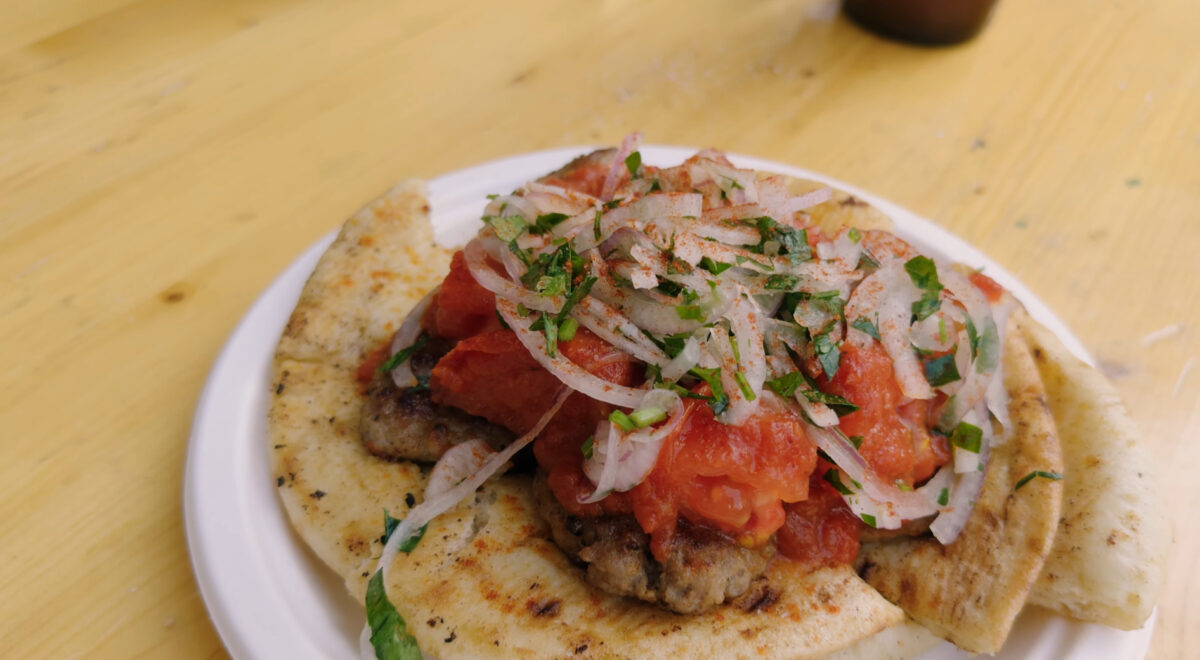
-
Quick bites
Small, fast options that let you keep walking before the day gets too heavy too early -
Simple plates
Something more settled once you’re ready to stop moving and actually stay put for a bit -
Drinks
Coffee first, then maybe wine, beer, or something stronger once the route starts loosening up
You don’t need the perfect choice.
You just need a good one, fast enough that the rhythm doesn’t fall apart.
That’s part of the charm here. You can make a small decision and keep going, or let a small decision turn into a longer stop without forcing it.
Why Modiano works so well inside a food tour
If you pay attention to how food tours move through Thessaloniki, a pattern shows up pretty quickly.
You begin somewhere lighter. Then the route tightens. Streets get busier, choices multiply, you’re looking left and right more often, maybe checking where the guide went for half a second because the crowd closed in. The energy builds.
Then it loosens.
That’s where Modiano slides in so naturally.
It gives the middle of the route some structure. Not a full stop, not a hard reset. More like a cleaner section where people can breathe, choose, eat, and stay connected to the pace of the day.
Instead of carrying the same level of street noise forward, you step into a space that has already organized itself. You don’t need to search around much. You keep moving, just more comfortably.
Modiano gives shape to the middle of a Thessaloniki food route. It turns scattered movement into a pause that still feels connected to everything around it.
Modiano Market vs Kapani Market
You feel it almost right away.
Even before the names stick, you know you’ve crossed from one into the other. Your pace changes. What catches your eye changes. Even the way you pick what to eat shifts a little.
That’s what makes the pair work so well.
| Modiano Market | Kapani Market | |
|---|---|---|
| Type | Indoor food hall | Open traditional market |
| Feel | Structured, clean | Busy, layered, less predictable |
| Food | Ready-to-eat, immediate | Ingredients plus scattered food stops |
| Ease | Very easy to enter and understand | Takes a moment to adjust to |
| Best for | First-time visitors, controlled stops | Immersive, more raw experience |
Kapani pulls at you. Modiano settles things down.
One spills into you from all sides. The other gathers itself. You notice it in your feet first — in Kapani you keep adjusting, turning a shoulder, stepping around someone, looking up to see where the gap is. In Modiano, you slow down without really deciding to.
If you only do one, you’ll still eat well.
But walking through both gives you a better read on Thessaloniki food culture. Not just what is sold, but how the city carries it.
- Market tours → how it works
- Kapani → compare market
- Best tours → top options
- Street vs market → see difference
When Modiano Market works best
There are days when Modiano makes immediate sense.
Usually the ones where you don’t want to spend ten minutes figuring out your next move.
-
On your first day
You walk in, glance around once, maybe twice, and the layout starts making sense almost immediately.
-
When you want a clear, easy stop
No circling, no second-guessing, no standing at a corner checking maps while people move around you.
-
As a midpoint in a longer walk
It gives the day a pause without breaking it. You stop, eat, sit a little, then head back out.
-
When you want to sit without committing too early
It’s easy to slow down here, then keep going once you’ve had enough.
In those moments, Modiano doesn’t feel like a stop you forced into the route.
It feels like where the walk was heading anyway.
When it doesn’t quite work the same way
There are other moments when it feels a little too composed.
-
If you’re looking for something raw
Modiano is shaped for ease. You don’t get the same edge, noise, or push you get outside in the older market lanes.
-
If you want to discover things by accident
It runs smoother, which sounds great — until you realize smooth can mean fewer odd little surprises.
-
If you’ve already adjusted to the city
Once you stop checking directions and start moving comfortably through the streets, this can feel more contained than you need.
That doesn’t make it weaker.
Just more specific.
Modiano works well as a bridge. You arrive still a bit unsure, make a few easy choices, get your bearings, then head back into the city with less hesitation.
So, is Modiano Market worth visiting?
Yes — just maybe not for the reason people expect.
You don’t go there because it overwhelms you. It doesn’t. You go because it gives shape to the area around it. You step in, slow down, choose something without much friction, and walk back out knowing the neighborhood a little better than before.
It sounds small. It isn’t.
That kind of ease matters, especially early in a trip, when every turn still asks for a bit of attention.
Quick takeaway
- First-time visitor: very useful starting point
- Food-focused trip: good as part of a larger route
- Short visit: efficient and easy to include
- Looking for intensity: combine it with more open markets
On its own, it’s clear and comfortable.
Add Kapani before or after, and it lands better. One gives you room. The other gives you friction. Together, they make the food scene feel less like a list of stops and more like something you’ve actually moved through.