

At first, Thessaloniki food tour prices look simple.
You open a few tabs. Scroll. One feels cheap. Another sits somewhere in the middle. A third jumps higher and you assume it must be “better.”
It lines up nicely. Almost too nicely.
Then you start clicking into the details.
You zoom in on the route. Check the stops. Try to picture how it actually moves. One listing keeps circling the market. Another spreads out across the city. One looks like quick bites. Another slows down for proper seating.
The neat ladder starts slipping.
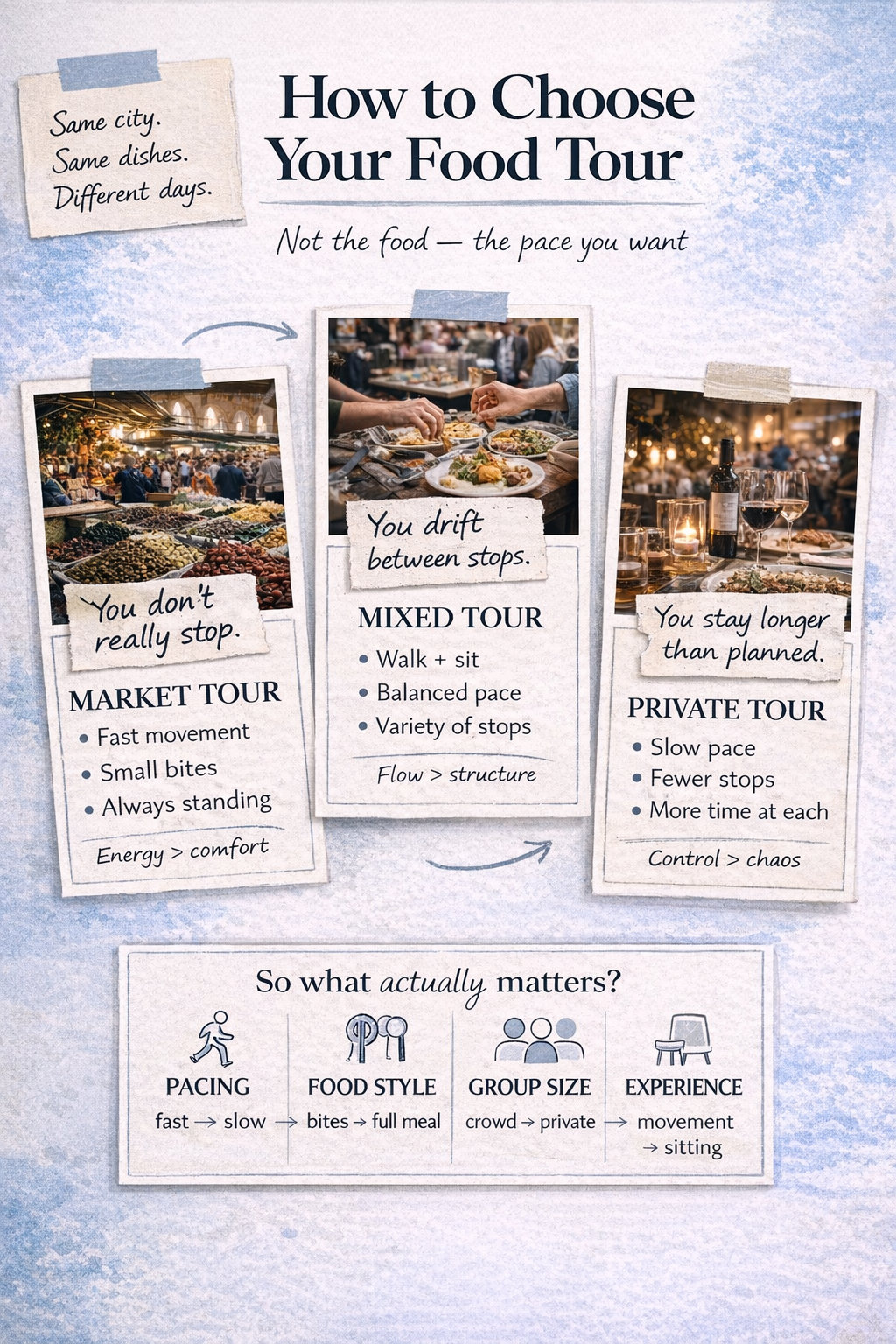
A lower-priced tour might stay inside the market grid, moving fast, stopping often, handing you small things you eat standing up. A higher one might cut the number of stops in half but stretch them out — you sit, you order drinks, you pause longer than expected. Private tours jump again, even when the food doesn’t look dramatically different.
So the question shifts a bit.
Not just what food tours in Thessaloniki cost.
What that price actually feels like once you’re there.
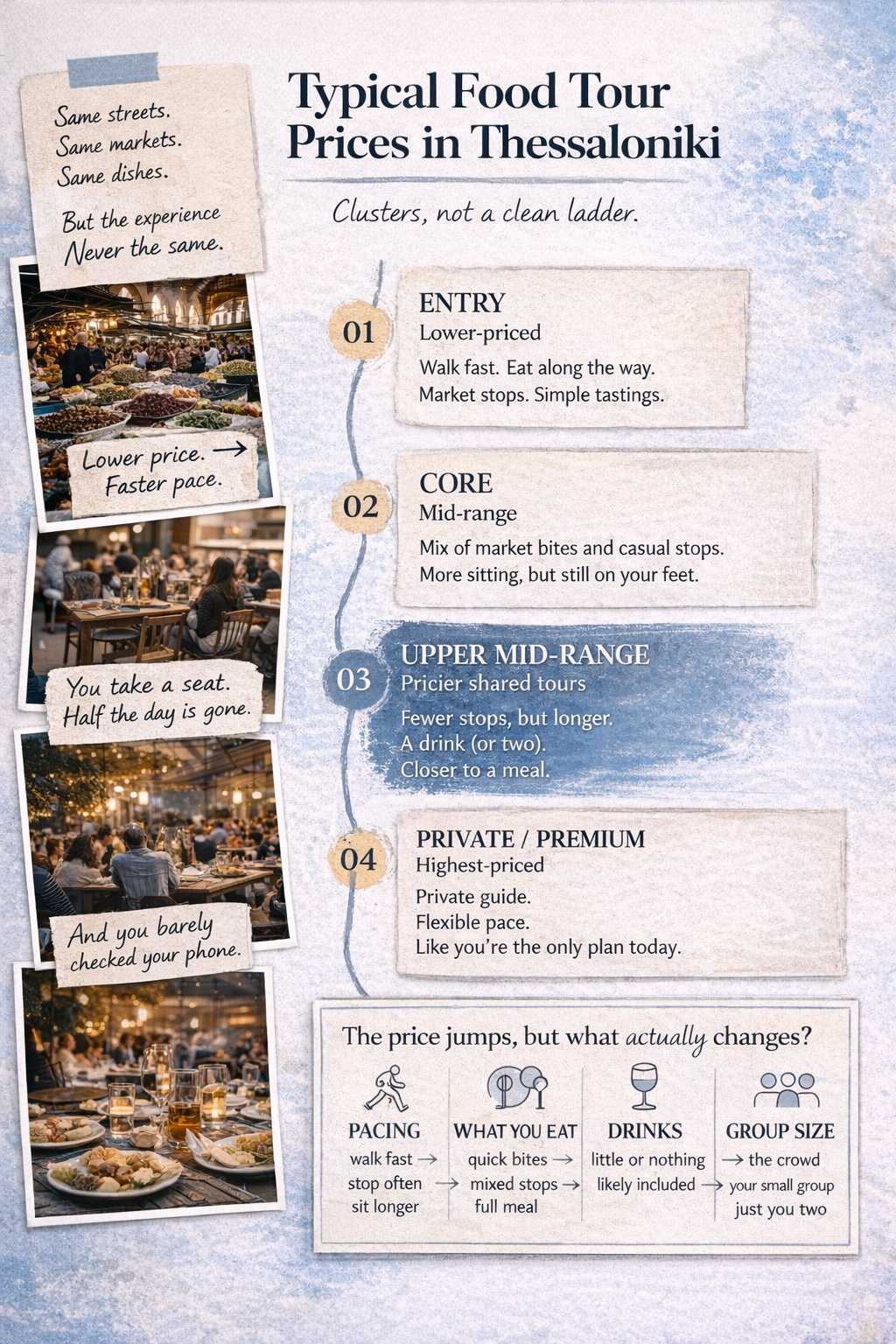
Most Thessaloniki food tours sit somewhere in the middle rather than at extremes. Cheaper options usually stay inside market routes with lighter tastings. Prices climb once the experience stretches into restaurants, drinks, smaller groups, or private pacing.
Typical Food Tour Price Range in Thessaloniki
When you look across available tours, the spread is clear — but not in a clean, linear way.
You start noticing clusters instead of a straight line. The lighter market walks at one end. Then a dense middle where things blur together. Then the quieter, more controlled tours at the top.
That middle is where people usually get stuck, comparing tabs, going back and forth.
| Tour layer | Typical price level | What it usually looks like | What changes the value |
|---|---|---|---|
| Entry | Lower-priced | Market-focused walking route, quick tastings, continuous movement | Mostly paying for guidance, access, and orientation |
| Core | Mid-range | Mix of markets and casual stops, more structured pacing | Better balance between food and city experience |
| Upper mid-range | Higher shared-tour pricing | Fewer stops but longer ones, drinks, or curated route design | Starts to feel closer to a full meal experience |
| Private / premium | Highest | Private guide, flexible timing, controlled route | Cost shifts toward privacy and customization |
It sounds tidy written like this.
It doesn’t feel tidy when you’re choosing.
You flip between two tours that cost almost the same. One looks packed with stops. The other barely lists them. One promises “authentic spots.” The other shows actual dishes. You open maps in another tab just to see where these places even are.
That’s usually the moment the simple price idea breaks.
Why the Cheapest Tours Tend to Be Market-Based
The lower end almost always starts in the same kind of space — central streets, open markets, tight walking loops.
You move a lot.
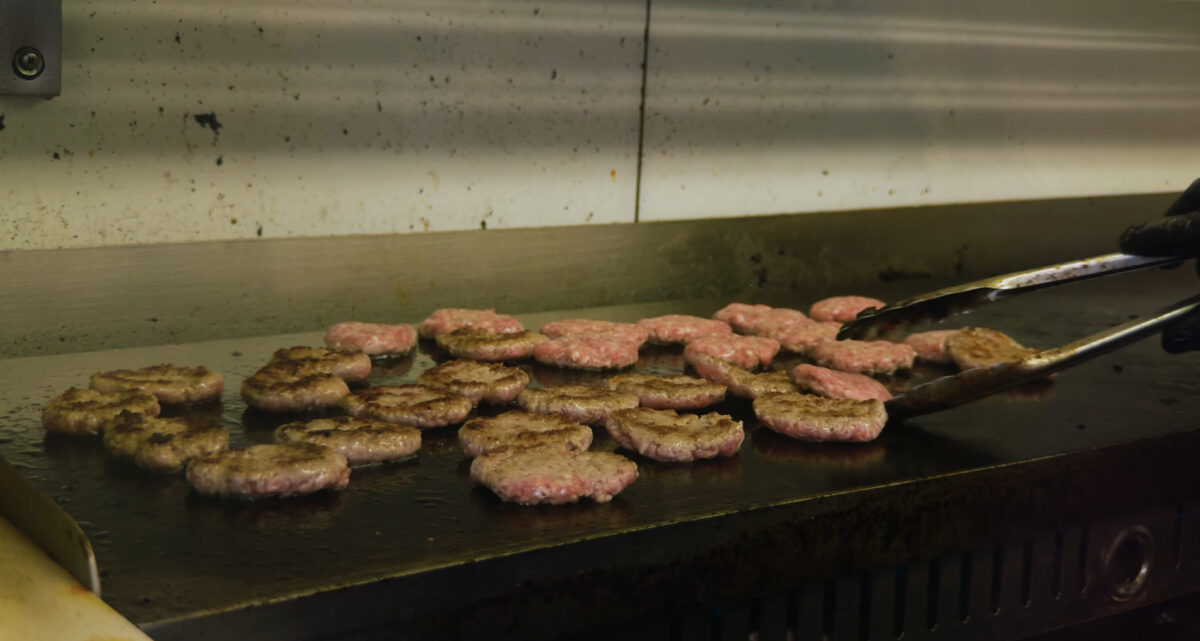
You stop, taste something small, keep going. Bread here. Olives there. Maybe something hot if the timing works. You don’t really sit. Or if you do, it’s brief.
You check your phone once or twice, just to see where you are in the maze.
Then you stop checking.
That format keeps things lighter on the operator side. No long table bookings. No fixed seating windows. Portions stay smaller, spread out across stops. It works well, just in a different rhythm.
People sometimes assume cheaper means a stripped-down version of something better.
It usually isn’t.
It’s just a faster-moving day.
Lower-priced Thessaloniki food tours tend to mean more walking, more market energy, and smaller tastings spread across many stops. Not worse — just lighter and more fluid.
The Main Price Band Most Travelers Compare
The middle is where things get messy.
Not chaotic. Just… harder to read.
Tours here start to feel more complete. You might begin in the market, then drift into side streets, then end up sitting somewhere longer than you expected. A drink appears. Then another stop you didn’t plan for. Time stretches a bit.
You glance at the clock and realize half the day is gone.
Listings in this range often sound similar. Same tone. Same promises. But they lean in different directions.
One gives you more food but keeps the route simple. Another cuts food slightly but adds drinks. Another stays compact but limits the group size so everything feels calmer. Another quietly relies on the guide to carry the whole experience.
Prices sit close. The days don’t.
Two tours can look almost identical in cost and still feel completely different once you’re on them — one feeds you more, another shows you more, another just feels easier to move through.
What’s Usually Included in the Price
Most tours share a kind of base layer. You start to recognize it after looking at a few.
- Food tastingsAlways there, but portions can feel smaller or larger than expected
- Local guideExplaining, navigating, sometimes adjusting on the fly
- Walking routeUsually weaving through the historic center and markets
Then some stretch beyond that.
A drink appears. You sit longer. One stop turns into a proper pause instead of a quick bite on the edge of the street.
Still, the foundation doesn’t really change.
That’s why comparing prices on their own feels off. Like you’re missing something.
Because you are.
You’re not picking between numbers. You’re picking how the day moves.
What You Are Really Paying For
When you search for Thessaloniki food tour cost, it feels like you’re comparing meals.
You’re not.
You’re comparing how the day is built.
- Route structureMarket-heavy routes usually cost less than ones built around seated stops and wider movement.
- Food volumeSmall tastings across many places feel very different from a tour that replaces a full meal.
- Group sizeFewer people often means a slower pace and a higher price.
- Included drinksWine or spirits shift the cost quickly, even if the food stays similar.
- Private formatYou’re paying for control of the day — timing, pace, and attention.
That’s the thread running through all of it.
Not cheap versus expensive.
But how the tour moves. How much you eat. How long you stay in places. How the day unfolds without you pushing it.
Some tours keep you moving the whole time. Others slow you down without you noticing until you’re already deep into it.
- Best tours → see options
- Worth it? → read this
- Private tours → compare
- First day → start here
Why Two Tours Can Cost the Same — But Feel Completely Different
You open two tabs. Same price. Same length. Same part of the city.
Looks easy. Pick one and go.
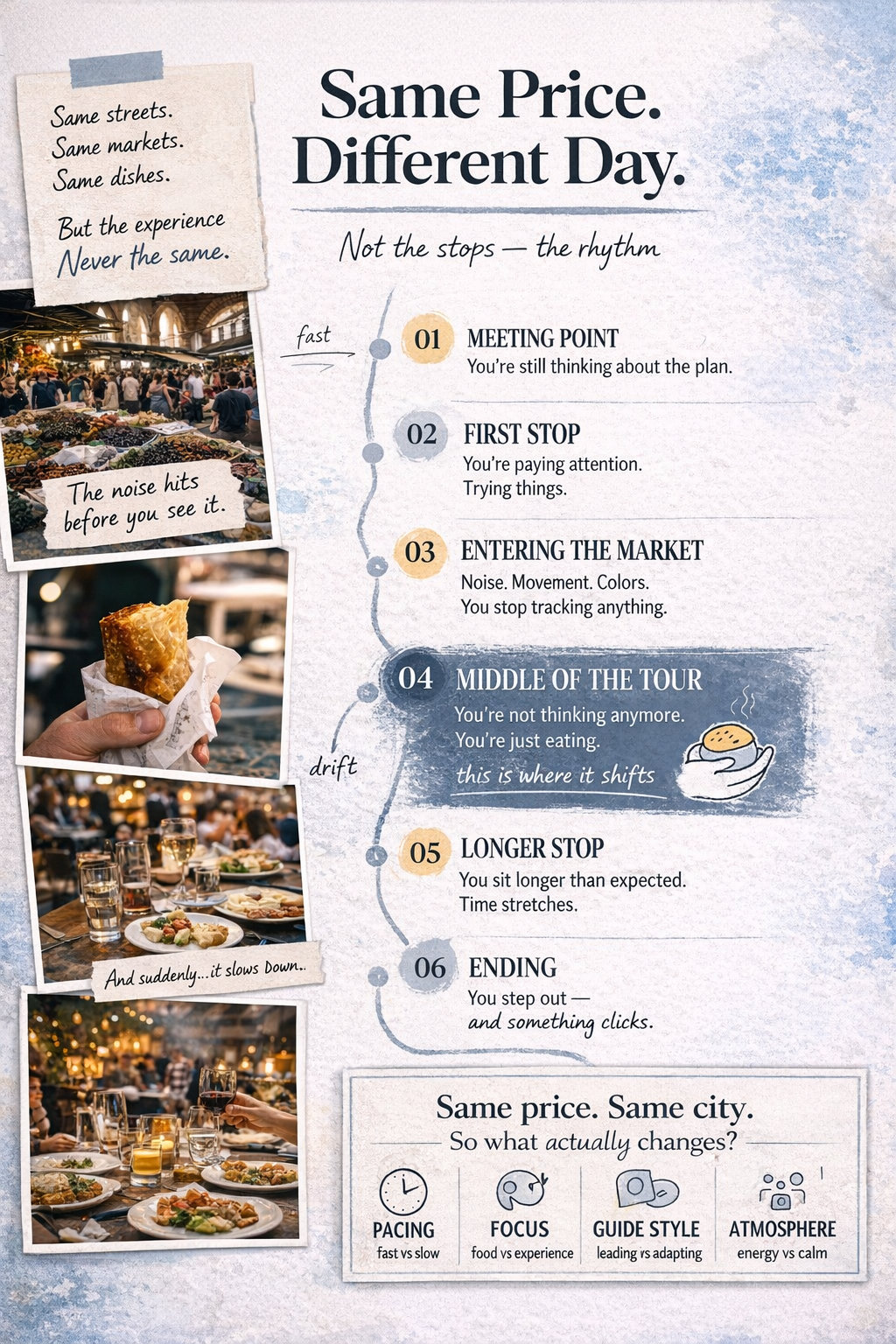
Then the day starts, and it drifts in two directions.
One barely slows down. You’re already walking before the first bite settles. A quick stop, something handed over in paper, a few steps to the side, then moving again. You check the map once, then stop bothering. It’s just follow, taste, keep up. A bit messy. Kind of fun.
The other one lingers. Chairs, plates, a pause between things. You sit longer than you planned. You start noticing details — the oil, the bread, the way something’s cooked. Time stretches a little. No rush.
Same money. Completely different rhythm.
| Tour style | How it moves | Food structure | What it feels like |
|---|---|---|---|
| Market-heavy | Continuous walking | Small tastings | Fast, energetic, varied |
| Mixed route | Walk + short stops | Balanced portions | Structured but still dynamic |
| Restaurant-led | Slower pacing | Larger portions | Closer to a real meal experience |
Most price breakdowns skip this part.
They flatten everything into one category. It doesn’t hold up once you’re actually out there.
It’s not really about how long it runs or how many stops show up in the list. It comes down to pace — quick tastings stacked together, or fewer places where you actually sit and eat.
Tastings vs Meal-Level Experience
You notice it pretty quickly once the tour starts.
Lower-priced routes scatter food across the walk. A bite here, something small there. Maybe a coffee somewhere in the middle. It builds a picture, but you’re still thinking about food afterward.
Mid-range starts shifting. Stops feel more intentional. Portions aren’t just samples anymore. At some point you realize — you’re not snacking, you’re actually eating.
Higher-priced ones don’t rush at all.
Fewer places. More time in each. Sometimes you sit long enough to forget there’s another stop coming. Drinks appear. The whole thing feels closer to a structured meal than a tour.
| Food level | What you get | How it affects price |
|---|---|---|
| Light tastings | Small bites across multiple stops | Lower |
| Balanced | Combination of tastings and proper portions | Mid-range |
| Meal-level | Enough food to replace lunch or dinner | Higher |
It sounds obvious, but people still miss it.
If it feels like a long snack, you’ll still end up looking for food later. If you slow down and sit, the tour quietly replaces a meal without you noticing when it happened.
Before comparing anything else, ask yourself: will I still be hungry after this, or am I done for the next few hours?
Where the Price Starts to Increase
Once you move past the basic walking-and-tasting format, the changes are pretty consistent.
You don’t always see them clearly in listings. You feel them during the first hour.
- Stops stretch out instead of staying quick
- Food becomes portions, not just samples
- Drinks show up as part of the route
- Groups shrink
- The path drifts away from the obvious center
It doesn’t hit all at once. One small shift, then another. By the third stop, the whole pace feels different.
Why Drinks Change the Price More Than You Expect
The moment drinks are included, the rhythm shifts.
You sit longer. You don’t rush out after a few bites. The places themselves change too — more space, more time at the table. The walking parts feel shorter even if they aren’t.
It’s not just adding a glass of wine.
It slows everything down.
You notice conversations stretching. Someone orders another round. The guide doesn’t push you out the door. Time slips a bit.
Adding wine or spirits nudges the whole experience toward staying in places instead of moving through them.
Group Size and Why It Matters More Than It Looks
You feel this one almost immediately.
Larger groups bunch up. You wait outside places. Orders take longer. The route sticks to spots that can handle the numbers. It works, but it’s less flexible.
Smaller groups move differently. You slip into tighter places. Less waiting. The guide has time to actually talk instead of managing the group.
It doesn’t look like much on the page. It changes the whole flow once you’re walking.
| Group type | Typical feel | Price impact |
|---|---|---|
| Larger group | Faster movement, less flexibility | Lower |
| Mid-size group | Balanced pace | Mid-range |
| Small group | More control, slower rhythm | Higher |
This is where people get tripped up.
Higher price doesn’t always mean more food. Sometimes it just means fewer people around you, less waiting, and a day that feels smoother without you quite noticing why.
That part — you only really catch it once you’re already in it.
Private vs Group Tours — Where the Price Really Jumps
At some point, the numbers stop creeping up. They jump.
You notice it when you scroll. One listing… then the next one is suddenly double. Same city. Same idea. Doesn’t quite make sense at first.
It usually comes down to this — group or private.
Looks like a small shift. Fewer people, maybe a nicer vibe. But once you’re actually on the street, it feels different almost immediately.
On a group tour, you keep moving. Not rushed exactly… but there’s a rhythm you don’t control. Someone checks the time, someone’s still finishing, the guide gently pulls everyone along.
You fall into that pace without thinking.
Private is quieter. You stop because you feel like it. You linger over something simple. Or skip a stop completely. No one’s counting heads.
At one point you’ll probably glance at your phone, thinking you’re behind schedule. You’re not. There isn’t one.
That shift — that’s where the price jumps.
| Format | What you gain | What stays the same | What changes the price |
|---|---|---|---|
| Group tour | Lower cost, shared atmosphere | Main food stops and dishes | Set route, fixed pacing |
| Private tour | Flexible timing, personal flow | Similar tasting structure | Guide focus and customization |
One thing that’s easy to miss.
Private doesn’t automatically mean more food. Or better food. You might eat almost the same things — same bakery, same market stall, same quick plate you didn’t expect to like that much.
What changes is how the day stretches out around it.
It starts to feel worth it when you care about time more than quantity. When you don’t want to rush through stops, or you’d rather sit longer with a drink instead of moving on. If you’re just there to taste things and keep going, a solid mid-range group tour already gets you most of the way there.
When Paying More Actually Makes Sense
Some upgrades are real. You feel them pretty quickly.
You sit down more. You’re not eating everything standing up or half-turned toward the group. There’s time to actually finish things.
- You slow down and stay longer at stops
- Drinks are part of the flow, not an add-on
- Groups are smaller, less waiting around
- The route drifts beyond the obvious central loop
- The tour quietly replaces a full meal
That’s when the price starts to feel… fair.
The tour stops being something you fit into the day. It becomes the thing the day builds around.
You look up and realize it’s already late afternoon. You didn’t plan that.
When It Doesn’t
Then there are the moments where you pay more and nothing really shifts.
It happens more often than you’d think.
Some tours look premium because the group is smaller or the branding feels polished. But once you’re there, the stops are almost identical — same market path, same quick tastings, same pace. You’re paying for space, not substance.
If your goal is to get a feel for Thessaloniki through food, a well-built mid-range tour already does the job.
You’ll still pass through the same streets. Probably lose track of direction somewhere near the market, check your map for a second, then give up and follow the guide again.
You’ll still try the same core dishes.
The shift sits more in the atmosphere than the plate.
How to Read Food Tour Prices Before Booking
After a while, patterns start to show up.
You scroll less randomly. You notice what pushes the price up without needing to read every line.
- Check the routeMarket-heavy routes usually stay lower
- Look at portion sizeTastings vs something closer to a full meal
- Notice the pacingMore sitting usually means higher pricing
- Check group sizeFewer people often means more cost, not always more food
- Look for drinksAlcohol quietly shifts everything upward
Once you start reading it like that, the numbers stop feeling random.
They line up with how the experience is built.
Most Thessaloniki food tours sit close to each other in price, but they don’t feel the same once you’re on them. The real shift isn’t the number — it’s how long you sit, how much you move, and how the day unfolds around the food.
- Best tours → see options
- Worth it? → read this
- Private tours → compare
- First day → start here